
Howard Tax Record Field Guide
Howard County splits a tax account into four parts: land identity, valuation, calculation, and payment. The Auditor's parcel card and the county-linked bill service each cover a piece. Watch the years. Indiana distinguishes an assessment year from its payable year, and confusing the two skews every comparison. So mixing them skews every comparison. The card itself warns against official use.
| Tax field | Meaning in the record | Howard custodian |
|---|---|---|
| Gross assessment | Value before deduction and cap lines | Assessor and Auditor |
| Taxable assessment | Assessment used in tax arithmetic | Auditor card |
| Deductions | Approved reductions shown for that year | Auditor |
| Charges and balance | Current, adjusted, paid, or delinquent amounts | Treasurer |
| Tax district and rate | Local taxing geography and applied rate | Auditor and bill |
Indiana assesses property at market value-in-use. That figure is not always the most recent sale price. A tax lien, meanwhile, is a legal claim tied to unpaid tax under the applicable process, so an open balance alone should never be described as a completed title transfer.
Howard Auditor Search Controls
The Howard Auditor tax list runs on one strong search key. Its own instructions warn that too much detail can block a match. Less is more with this tool.
| Control | Format | Tax use |
|---|---|---|
| Dist# | Text | Known taxing district |
| Parcel # | Full Howard APN | Exact parcel account |
| Name | Owner name | Recover split or combined bills |
| Tax Year | Menu | Change the yearly view |
| Property Address | Situs text | Locate a known site |
The page offers Search, Next, Back, Home, and Clear. Choosing a different tax year changes the account view only, so copy the complete parcel number before moving on to deed research.
Read Howard Assessment Arithmetic
A Howard parcel card stacks its numbers in a sequence that rewards reading in order. Gross assessment comes first, then cap or deduction lines, TIF assessed value, exemptions, taxable assessment, the tax rate, referendum lines, and current charges. Follow that order. A deduction can shrink the taxable assessment. The gross value stays put.
The same card carries the deeded owner, legal description, acres, township, school district, and tax district. Those fields confirm the right parcel is open. They do not turn a tax card into a deed or an appraisal.
- Assessed value
- Value assigned under Indiana mass-appraisal rules.
- Market value-in-use
- The Indiana standard based on a property's use.
- Deduction
- An approved reduction in tax arithmetic.
- Tax lien
- A legal claim arising from unpaid tax, distinct from an ordinary balance.
Howard Tax History by Year
Yearly history entries on the Auditor's records run from 2012 through 2025. Each line tracks assessments, deductions, gross tax, credits, taxes, and historical amounts. That span invites comparison. Resist assigning a single cause to any change without checking the underlying notices.
Record both the tax year and the payable year. Compare annual trending, approved deductions, the local rate, and adjustments side by side. A deed's sale consideration is a transaction field. It cannot stand in for assessed value.
Look Up a Howard Tax Bill
The Treasurer's office keeps current tax information, payments, warnings, rates, judgments, tax-sale records, and certain ditch, sewer, weed, demolition, and nuisance charges. Start at the Auditor. Pull the parcel key and legal description from the card, then check the Treasurer account for status.
- Search the Auditor by address or full parcel number.
- Confirm legal description, district, township, and acreage.
- Select the intended year and note its payable year.
- Review assessment, deductions, installments, adjustments, and balance.
- Confirm payment or sale status directly with the Treasurer.
- Assessment year
- The year tied to the valuation.
- Payable year
- The year when that tax is billed.
- Tax rate
- The rate applied within the listed tax geography.
- Balance
- The account amount shown at the portal's update time.
Howard Due Dates and Payments
The Howard County Treasurer posts 2026 due dates of May 11 and November 10. Partial payments are accepted. County instructions also list participating banks for on-time payments, an entry drop box, and cash, cashier's check, or card payments for taxes and removal from certified tax sale. Confirm the details first.
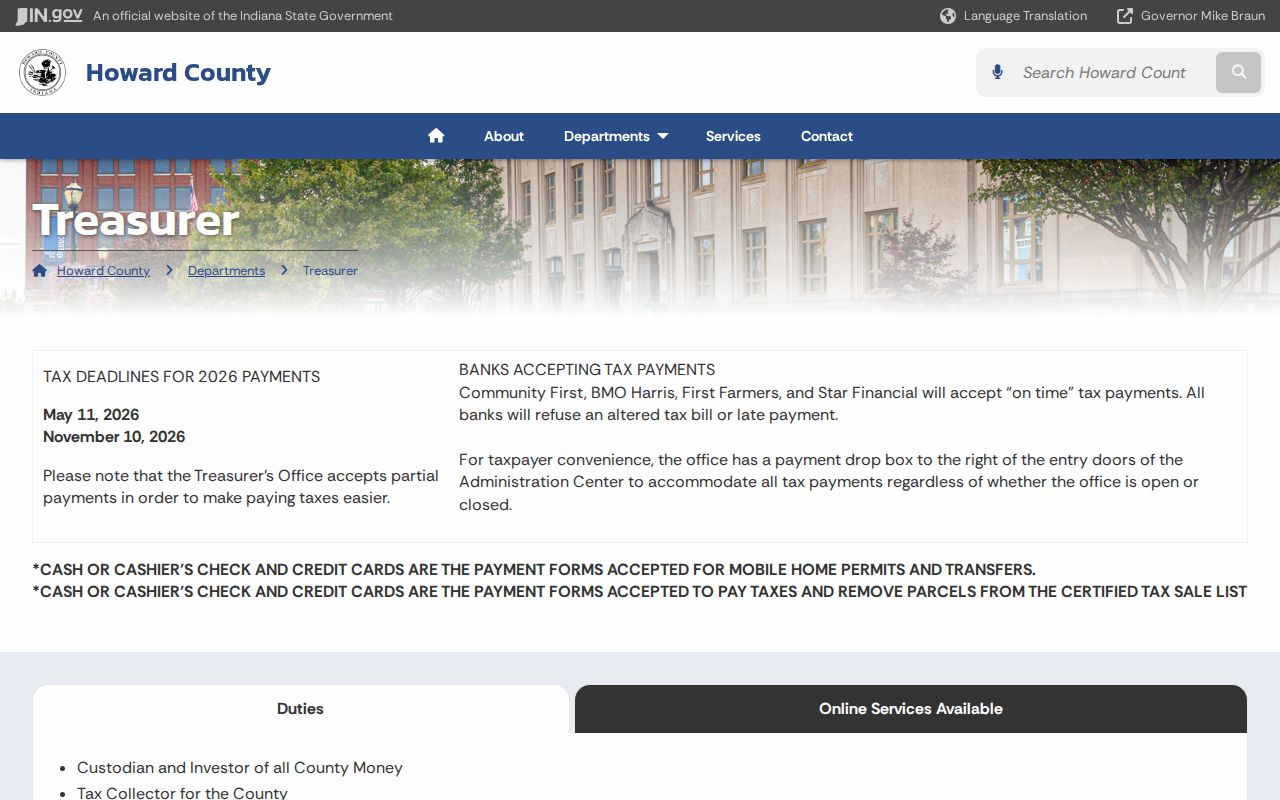
The Treasurer's payment page identifies the right channels, while the live version controls current dates. InvoiceCloud allows one-time payment without registration. Posted convenience charges run 2.95 percent for cards with a $2.95 minimum, $1.75 for ACH, and another $0.95 for IVR. These are vendor charges, not Recorder fees.
Note: Future due dates and payment charges can change, so check the current Treasurer notice before sending funds.
Howard Deductions and Exemptions
Deduction guidance lives with the Auditor. Form 136 exemption applications go to the Assessor, which also serves as secretary to PTABOA. A line on a tax card shows how an item was treated. It applies to that account in that year. It does not establish continuing eligibility.
Compare the account against the current application or notice. Verify ownership, occupancy, documentation, and filing dates with the responsible office. After a sale, deed, assessment, and deduction records may refresh at different times.
Taylor Township Reassessment Cycle
Reassessment is coming to Taylor Township. The notice also covers eastern Howard County. Under the DLGF schedule, work begins July 1, 2026, for 2026 payable 2027 and reaches about 25 percent of parcels each year through a four-year cycle.
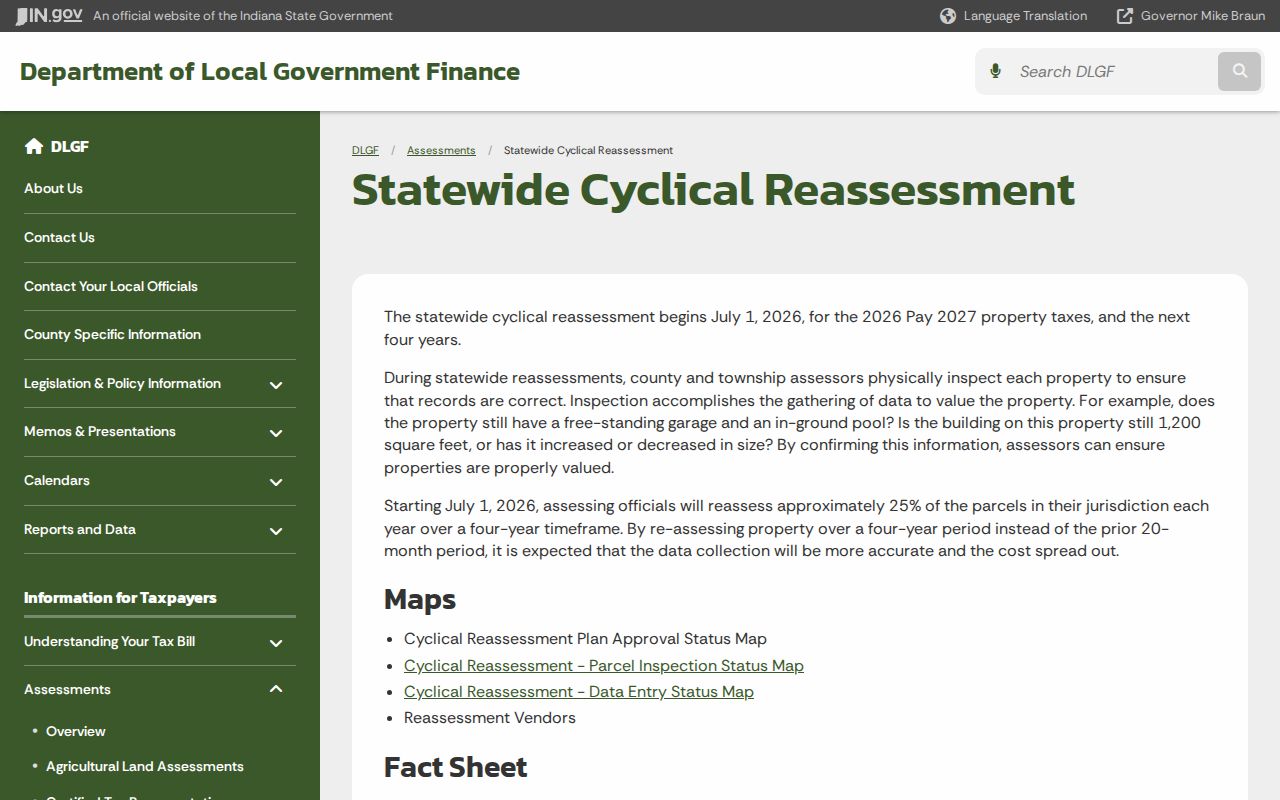
State timing is only context. It won't pinpoint a parcel's inspection date. Physical inspection and annual trending are distinct, so record the assessment year, the notice, and the card update date.
Howard Charges Need Classification
The Treasurer's responsibility runs past base real-estate tax into ditch maintenance, sewer-line, weed, demolition, nuisance, judgment, and tax-sale items, all named in county material. The county-linked bill structure also itemizes taxes, delinquencies, fees, adjustments, and balance. Write down the label exactly. Only then decide what the amount means.
A charge is not automatically a recorded lien. A delinquent balance is not a deed. Confirm the status word. Was the item billed, certified, judged, paid, released, advertised, or carried into a sale process? Those status words keep a lookup honest. When the source is a judgment or municipal charge, request the underlying record instead of treating the tax summary as complete evidence.
The revised 2025 tax-sale advertisement makes the point. It listed parcels, deadlines, sale logistics, and redemption terms for that cycle. An old list can linger online after removal, redemption, postponement, correction, or sale. For current property tax status, check the live Treasurer account and ask the office whether the parcel was removed, redeemed, sold, or carried forward.
Howard Value Sources Differ
Three Howard County offices shape the numbers. Each answers a different question about the same parcel. The Assessor sets market value-in-use through mass appraisal and sales-disclosure review. That office also runs annual trending built on prior area sales. The Auditor card shows the assessment arithmetic and deductions. The Treasurer then lists charges and payments. A recorded deed or sales disclosure may state consideration. That transaction figure is not an appraisal.
Indiana targets a 100 percent ratio to its market-value-in-use standard. That standard does not promise equality with a prior sale price or a future offer. Condition, use, valuation date, neighborhood model, exemptions, and transfer timing can each pull the figures apart across records. So the records can disagree for plain reasons. Keep source labels intact across years. Gross assessment, taxable assessment, tax rate, deductions, and credits are not interchangeable. Neither are itemized taxes, payments, and balance. A valuation question belongs with the Assessor and DLGF. Billing goes to the Auditor and Treasurer. A sale-price question starts with the recorded instrument and its sales disclosure.
Contest a Howard Assessment
Howard County appeals start locally. Form 130 opens the local review. From there the case can move through Howard PTABOA and, if needed, the Indiana Board. The DLGF appeal page supplies the current form. Form 11 timing and the June 15 rule in state guidance can affect the filing window. So follow the dates on the actual notice received.
Gather the property record card, legal description, factual corrections, comparable sales, photos, and any appraisal. Paying the tax and disputing the value are separate tasks. Both can move forward at once.
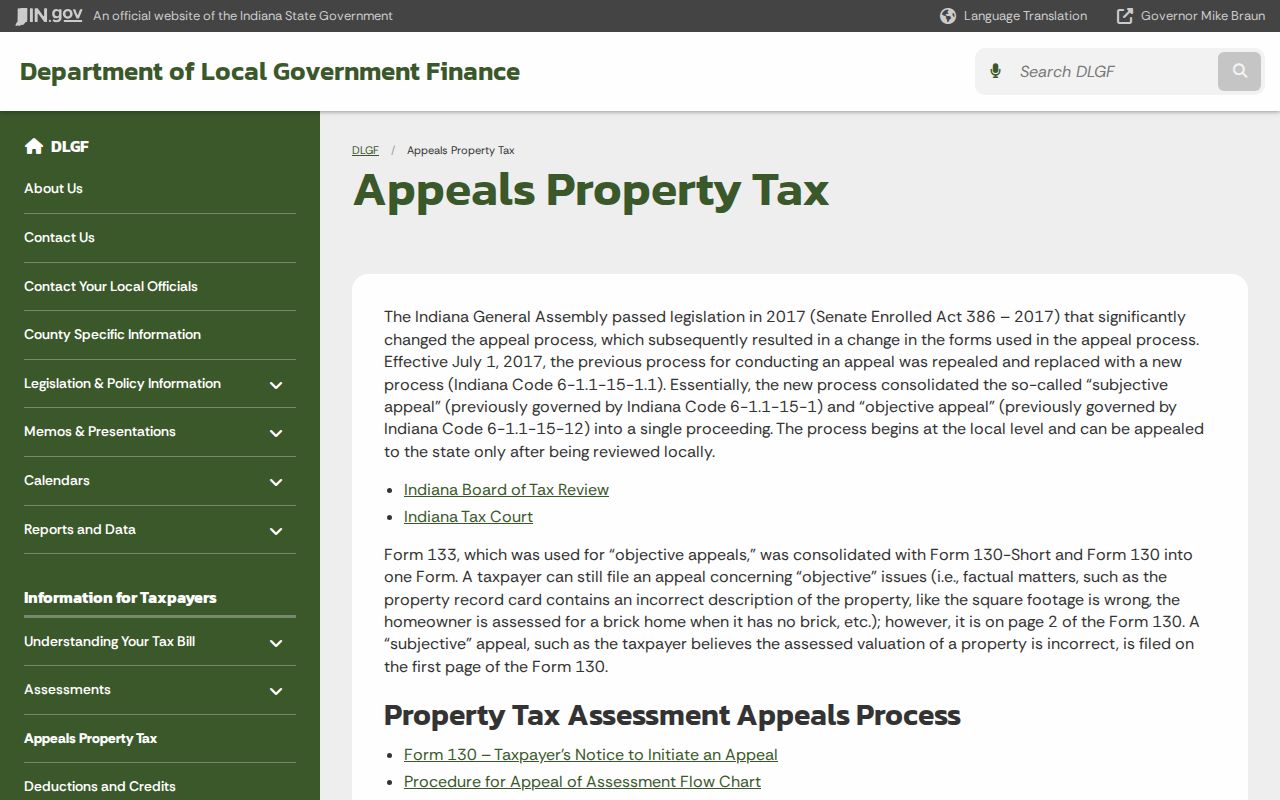
The state page links the official appeal form. The notice itself supplies the controlling dates for the parcel and its review path.
Appeal window. Use the date and directions on the assessment notice. Confirm the Form 130 deadline with Howard County before filing.
Keep the paper trail whole. Save the filed form, evidence list, delivery proof, and every resulting notice. Track the case or petition reference too. If the property record card changes later, compare the new assessment year and payable year instead of overwriting the prior figure. Howard's systems update on different cycles. A current tax account can appear while deed, map, or permit data lags behind.
Tax-sale research needs status words as well. The official 2025 advertisement was a dated notice with sale and redemption terms, not proof that every listed parcel sold or that title changed. Was it removed, redeemed, sold, or carried forward? Then check the Treasurer and the latest Recorder instrument. Current status should never be inferred from an old advertisement.
Howard County's linked bill example separates the parcel, duplicate number, legal description, property address, tax unit, township, due dates, itemized charges, and taxpayer section. That layout helps verify identity before payment. Avoid republishing a private mailing address, retain only the fields needed to explain the account, and confirm any disputed amount with the office that posted it.