
Howard Deed Types and Uses
The Howard County Recorder records deeds and the many instruments that touch land. An index entry points the way to an image. The instrument itself does the real work. It supplies the parties, the legal description, recording data, and the transfer language a property search needs. Deed labels matter. They describe the form of conveyance in the deed records. They are not a promise that every ownership question is settled.
| Deed Type | What It Does | Common Use |
|---|---|---|
| Warranty deed | Conveys the stated interest with deed covenants | Ordinary purchase trail |
| Quitclaim deed | Conveys whatever interest the grantor holds | Family or title cleanup |
| Trustee or representative deed | Conveys through a named legal capacity | Trust or estate transfer |
| Sheriff or tax deed | Records a conveyance after a statutory process | Sale-result confirmation |
| Corrective or re-recorded deed | Repairs or republishes recorded information | Name or description correction |
A mortgage or lien is an encumbrance. It is a recorded claim against the parcel rather than a conveyance of it. Each one leaves its own trail in the deed records. Search releases, assignments, subordinations, and re-recordings separately. A later document may cite the original instrument number, and that reference often explains why an older lien still shows up in the recorder's index.
Howard's Split Online Coverage
The Recorder's online-records page describes its coverage two ways. The overlap matters for any Howard County property search. One statement puts images and indexes in the current database from January 1, 1961 forward. Another says every deed image and index lives in Laredo from 1923 forward. Deed document types from 1844 through 1923 are still being indexed. Keep that split in mind. Not every 1844 deed is searchable online, so do not assume otherwise. Ask the Recorder whether the document type and year you need is indexed. Turn to the office, microfilm, or a finding aid when it is not. For occasional research, EON offers a pay-as-you-go property search. Laredo, by contrast, runs on an account and escrow model. It is built for frequent deed records work. The county's online deed access notice displays the Recorder's published coverage and pricing context.
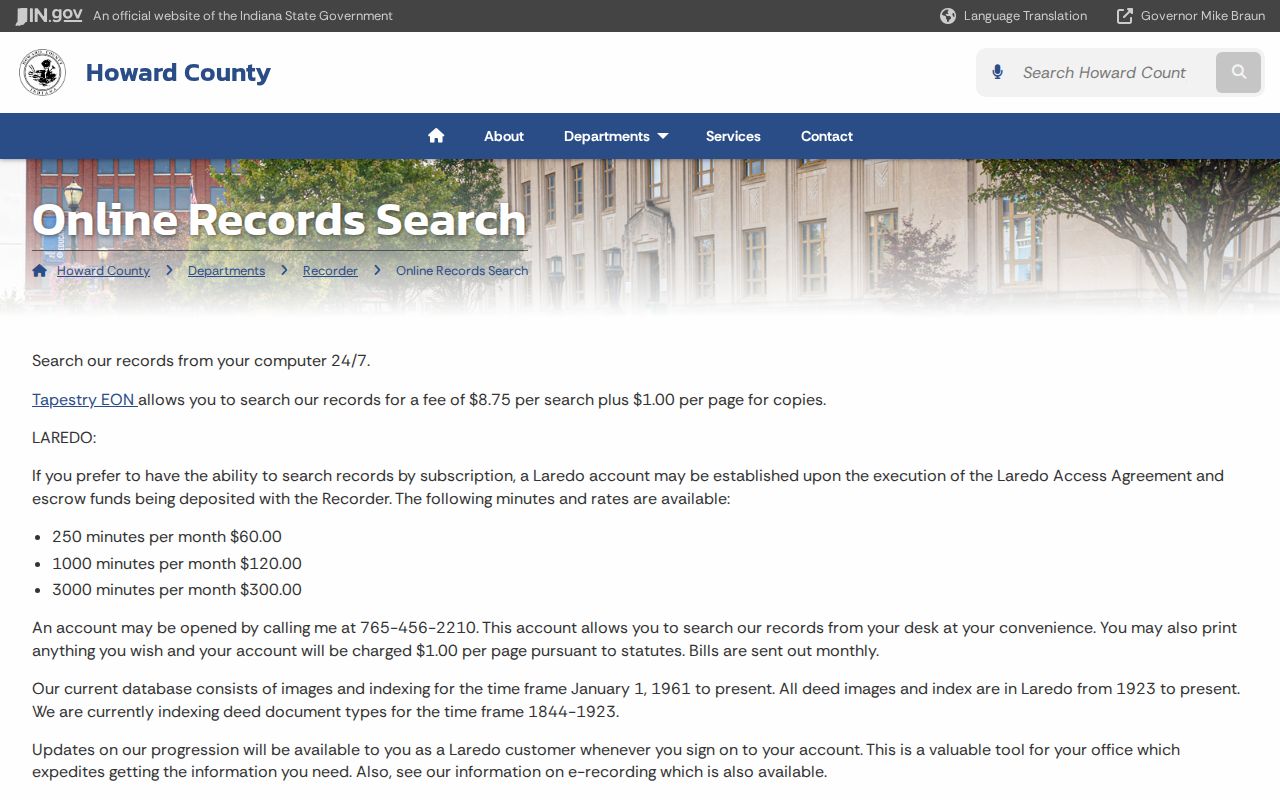
Note: The image is a routing aid only, and the live notice controls whenever coverage or charges change.
Note: Coverage depends on both year and document type, so a blank vendor result does not establish that no deed exists.
Howard Recorder Search Inputs
The vendor route requires payment, so plan the search inputs before paying for anything. Party name, document type, and recording period are reliable fields for a Howard County deed search. Legal-description words help too. Start with the exact spelling on the latest tax card. The Recorder-linked Tapestry EON service is the destination for an occasional paid property search.
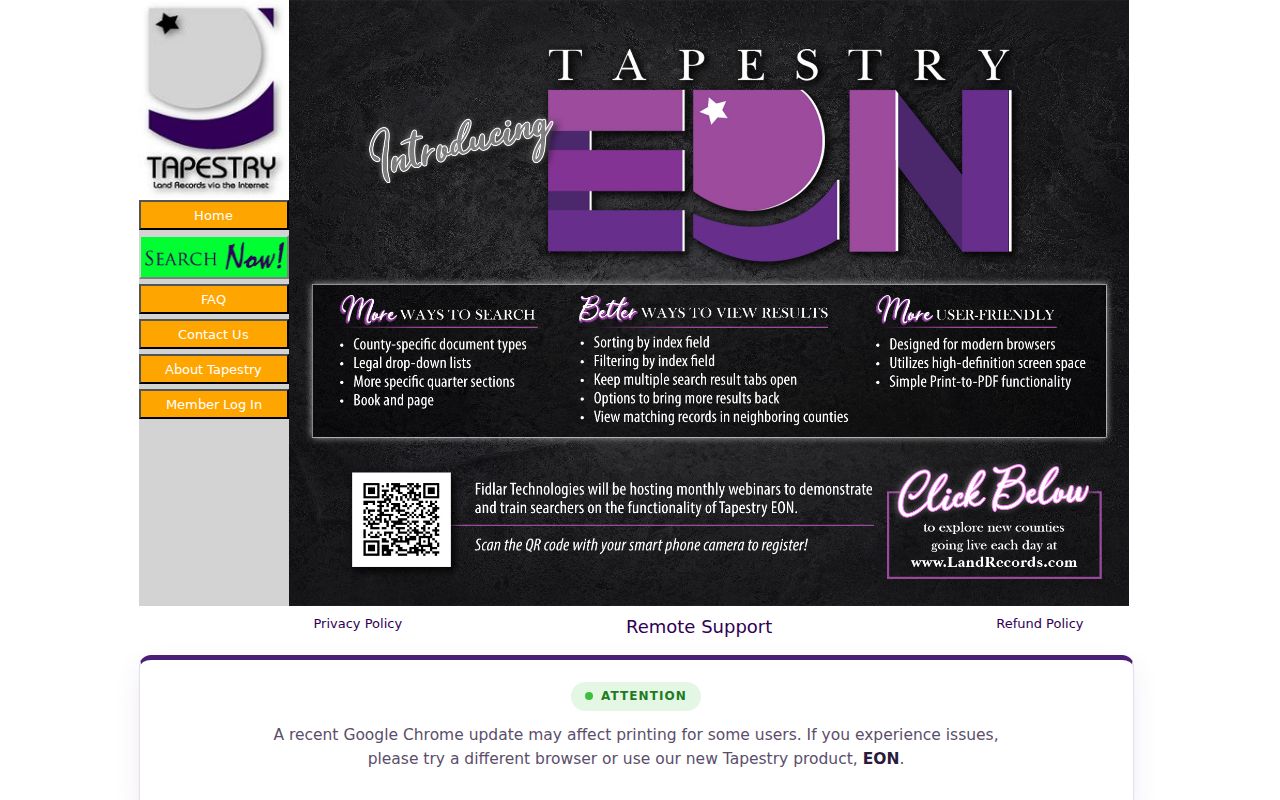
This view confirms the vendor handoff, not a county-specific deed result.
| Search fact | What to capture | Why it matters |
|---|---|---|
| Party | Grantor, grantee, trustee, or representative | Finds the indexed name and capacity |
| Instrument | Deed type and referenced document | Separates transfers from liens or releases |
| Date | Recording date and useful range | Orders the chain |
| Land text | Subdivision, lot, block, section, or tract | Controls same-name matches |
Search exact entity names and suffix variants. For a trust, try both the trustee and the trust name. Estates are stricter: keep "executor," "administrator," or "personal representative" exactly as recorded, because those roles are not interchangeable in the deed records.
Read Howard's Grantor-Grantee Chain
A grantor gives the stated interest. A grantee receives it. Read a Howard County chain backward from the current deed, one conveyance at a time. Match the legal description at every step, since one owner may hold several parcels and a single tract can split, merge, or be replatted along the way.
- Copy the Auditor card's deeded owner, APN, and full legal description.
- Find that owner as grantee on the most recent matching deed.
- Read the grantor and prior-instrument references from the deed.
- Search that grantor as an earlier grantee, then repeat while the land text still matches.
- Move to deed books, microfilm, and archive finding aids when online coverage ends.
- Grantor
- The party transferring the stated interest.
- Grantee
- The party receiving the stated interest.
- Chain of title
- The linked sequence of ownership instruments for the same land.
- Book and page
- A volume-and-page reference used to retrieve an older recorded item.
- Instrument number
- A unique recording reference assigned to a filed document.
Howard Deeds Before the Portal
The State Library's Howard guide identifies Index to Land Deeds Book A. It covers 1844 through 1847. Its microfilm inventory lists grantor and grantee index groups from 1846 through 1902. It also lists tract-book material from 1842 through 1853. Overlapping years mean separate volumes, not one complete digital run. The Howard County microfilm inventory is a finding aid. It helps you pick the right roll. But the index entry still has to lead you to the deed itself. For a parcel whose chain predates Howard County's 1844 creation, follow the parent-county trail. Howard was formed from portions of Carroll, Cass, Grant, Hamilton, and Miami counties. Those deed records hold the earlier links.
Kocomo Names in Deed Records
Early local records may spell the city name Kocomo or Cocomo rather than Kokomo. That difference can hide an owner, plat, deed, map, or newspaper reference even when the family and land are right. Preserve each source's spelling. Search all three variants. Addresses also change over time, while legal descriptions tend to outlast them. Words like "part of," "except," "replat," "vacated," and "corrective" deserve close attention in any Howard County property search. The Prairie Farms and Mohr Drive right-of-way vacation recorded in Kokomo code shows how a later legal action can alter the access an older plat appears to grant.
Howard Deed Fees and Access
The current Recorder page prices Tapestry EON at $8.75 per search plus $1 per page. An older Recorder FAQ lists $6.95 per search plus $1 per page. So check the live page before you buy. Laredo plans run 250 minutes for $60, 1,000 for $120, and 3,000 for $300. Recording fees are separate from vendor charges. The county fee schedule effective January 1, 2021 sets deeds and most other instruments at $25. Mortgages are $55. Standard copies cost $1 per page, large copies $5 per page, and certification adds $5. Confirm current costs and the exact retrieval method with the Howard County Recorder before ordering anything.
Howard Property Fraud Alerts
The Recorder points property owners to Howard Property Fraud Alert. It is a free sign-up that sends notice when a matching name shows up in newly recorded Howard County instruments. It watches the deed records. It stops nothing. An alert simply tells you to pull the actual instrument. Then call the Recorder about anything suspicious.
Enrollment name and indexed name must match. That is not always simple. Trusts, entities, initials, and changed surnames may be recorded under a different spelling. It may not match the spelling you registered. Alerts pair well with a periodic deed-record review in Howard County property records. Yet they prove nothing about title or a document's validity.
Howard Plats Preserve Land Names
Street addresses change. Subdivision names endure. Howard County tax-sale descriptions and sample cards preserve plat names. They include Championship Park of Kokomo, Bellaire Gardens, Kennedy Park Section 2, Charles M. Steele's, Washington Heights, Western Heights, Highland Grove, Webster Crossing Section 6, and Prairie Farms. Treat each name as a lead. Then confirm the exact lot, block, section, or part-tract wording against the deed and plat.
West Liberty proves the point. County code places the plat in Union Township near Greentown at plat book 1, page 170. Yet a 2003 action vacated easements and ways. Relying on the original plat alone could hide a later access change. Whenever current geometry or legal text differs from the earlier conveyance, search terms like "vacated," "replat," "corrective," "re-recorded," "part of," and "except."
Historic owner maps from 1899, 1906, and 1917 can bridge a name to a tract when the deed index is hard to read. They are not conveyances. Mine them for spelling, road, and township clues. Then return to the Recorder index, microfilm volume, and actual deed. A reproducible note identifies whether each source is a map, index, image, abstract, or certified instrument.
Order a Howard Deed Copy
Pull an online image through the EON or Laredo route, or ask the Recorder for a counter or requested copy when the record is unavailable there. Give staff party names, an approximate recording year, deed type, parcel or legal description, and any book, page, or instrument reference you already hold. Say whether a plain or certified copy is needed.
The office sits at 220 North Main Street, Room 101, Kokomo, with weekday hours listed from 8:00 a.m. to 4:00 p.m. Phone and office contact help with an early volume, unclear index, or coverage question. Staff can check recording requirements. They cannot give legal advice.
Recorded, not guaranteed. Howard deed records show what reached the Recorder. They do not resolve unrecorded interests, legal priority, or clear title.
For mail or counter requests, name the record family and date range. Don't ask for everything about a person. Include grantor and grantee names and entity suffixes. Add an approximate recording date, document type, APN, and exact legal-description terms. Ask whether the response is an index entry, plain image, or certified copy.
Keep cross-references with your copied deed. A corrective instrument, re-recording, assignment, release, court order, or later plat action may explain what the first deed omits. Sorting by recording date aids research. It does not establish legal priority. Priority and enforceability rest on the official instruments and professional review.